Tembea Youth Centre for Sustainable Development is an indigenous community based development organization based in Siaya District, Nyanza Province, Kenya.The CBO was founded in 2003. Tembea’s main goal is to enhance socio-economic capacities of communities through asset based community development approaches. The centre works hand in hand and in collaboration with the local youth so as to achieve self-reliance and sustainable livelihoods. They strive to accomplish this through environmental conservation and poverty alleviation programs at grassroots levels.for more info http://www.africa-adapt.net/aa/ProjectOverview.aspx?PID=racV2hXQtO8%3D
Tuesday, June 29, 2010
Tembea Youth Centre for Sustainable Development

Sunday, May 23, 2010
first week in Nairobi
 The moment when I first got out the air plane in Jomo Nairobi Airport 4 am in the morning, I know this will be a comfortable summer -- never hot when you sleep and under the shade; only hot when you need to walk anyway at noon.
At times mild and at times intense, this is my impression garnered during the first week in Nairobi. Thanks to the proceeding of the Convention of Biological Diversity, there are many technical meetings, side events. On Saturday a big celebration of the International Day of Biodiversity, I participated in the whole day's events--hatched along in a way, given my "blue pass" status(~~~).
Agriculture has a huge impact on biodiversity. Modern farming practices have meddled around with the diversity of plant and animal species in many ways. Mono-culture for one thing has not only artificially created new species that are decided to provide the maximum yield but at the same time erased many other plant and animal species. In case of genetic modification, the other, forest clearing, for example. In the picture to the right, it is a group of people made up of regional farmer coordinators and farmers themselves. They were here to display the variety of grains, crops, vegetables people of Kenya have been growing for centuries and millennia. They also prepared dish to show people how you could make yummies out of the indigenous crops. Maizes, beans, peas of various sizes and colors, and sorghum, potatoes and sweet potatoes...and speaking of sweet potato, now you see why I was holding a bag of them in my hand -- they just gave that bag to me while I was expressing my affection of them and how it is considered a longevity food in China. They also gave me a bag of ground grains mix (maize, sorghum,etc) for breakfast porridge, and a bag of mung beans (Chinese favorite for summer drink and porridge). We agreed that next time the coordinator goes in town. She will bring stuff for me directly from the farmers.
With the splashing in of western food culture and imports, traditional dishes made of these various ingredients have almost disappeared from the streets of Nairobi. What came instead are numerous of fast food restaurants called "Chicken Inn" selling roasted/fried chicken, fish and chips and samosa too. Local dishes like Sumuku wiki (literally, "get-me-through-the-week" low budget kale/spinach), Ugali (made of ground maize flower), can only be home-made by your mum and dad. This is what I have always see as an almost unavoidable lack of appreciation of one's own cultural, ethical and endemic crystal in the face of western popular monoculture. Conventional wisdom in this case isn't some taboo to be dodged, but perhaps to be given more scientific study to be recognized of its true health, environmental and socio-cultural value.
Bon, something other than food~~~some brief stories about other aspects of Nairobi.
 Corruption is national and continental headache. Every generation of governments and PMs have made pledge to combat corruption yet the results scatter. Thus the university has gone this far to put up the board in front of its gate to demonstrate its infallibility. I have also seen big and small boxes placed in various locations for citizens to report of corruption crimes. Don't know if they work at all.


 Corruption is national and continental headache. Every generation of governments and PMs have made pledge to combat corruption yet the results scatter. Thus the university has gone this far to put up the board in front of its gate to demonstrate its infallibility. I have also seen big and small boxes placed in various locations for citizens to report of corruption crimes. Don't know if they work at all.
Matatu, or Ma-3, THE public transport. Usually it takes 20 shilling for me to go to town from UNEP. Pretty wild services. prices depends on the time of the day. It could also be very personal the interior decoration -- some put up club lights all sorts of crazy stickers. But all, have very very loud loudspeakers inside them. It is a truly mobile home video treatment!

This is a picture taken on top of a bio-center built with the technical and financial support from Chinese Embassy in Kenya and two Chinese film stars. A biogast plant producing cooking natural gas is built along the public toilets on the first floor. The third floor is used as a commual meeting place. It is located at the heart of an urban slum on the very verge of Karura Forest. The forest was once completely deforested, until came the dedicated work of Dr. Wangari Maathai, the Kenyan Nobel Prize laureate for her influential environmental movement in African. She started the Green Belt movement.
Anyway, the guy in the picture, David, is a young man born and raised in the slum. He accompanied me while visiting the village. He speaks fairly good English but was currently unemployed. In fact he said only 25 percent of the whole population in the slum have work. The others just hang around, some collecting honey from the man-built behaves in the forests, keeping goats. David wanted to have a motocycle of his own so he could transport people to make money. He thinks people will trust him more because he can speak English. To quote one more thing from him, he told me, "don't give us food, give us knowledge instead. I have no more education. But I will have my children learn more than I do so can have a different life."
The visit was the last item of the celebration agenda. On the way back to the UN compound, an Australian delegate to the Convention on Biological Diversity sitting next to me commented on the lavish three-storey gated house just 20 meters way from the slum -- such sharp contrast of the inequality. I wasn't that surprised, to say the truth, we have looked through many pictures of drastic boundary line of the two extremes in the urban studies class. It is a classical struggle. It has accentuated and culminated in never-before-seen magnitude. Poverty, inequality and environment, a loop of interwoven issues, no one is sure where to start.
Wednesday, May 19, 2010
Embracing Nairobi, experiencing UN
About a year ago, an MHC alumna who had worked in UN Environmental Program told me that it was a critical time for UNEP, in the aftermath of the Kenya political turmoil and UNEP's own internal changes. It would be a good timing if you were interested...Yeah sure, I said, life and death, I am interested, just need to wait until I get my masters and Phds.
Or maybe I don't have to. UN is always in need of college students to labor for it anyway. It worked out between me and UNEP.
Now Kenya's new power-sharing government has been once again stabilized (both sides realized the cost of damage done to their once relatively stable prosperous country). A serious of activities led me here, even Satinder, the director of the communication divison who made me a recommendation was surprised to see me here. You never know. Stepping into the security gate, and walking alongside the 200-sth national flags that lead to the main office building, my heart cramped. I dont even remember since when I had the obsession with UN. This was historical for me.
UNEP and CYCAN has had long standing collaboration over the past. A lot of what I will be doing could be largely drawn from my experience working with CYCAN with youth outreach, media relations. Our focus for this summer will be on the promotion of World Environmental Day (http://www.unep.org/wed/2010/english/) on our Chinese website and social networking site RenRen (the Chinese version of facebook, basically), and the later the same for UNEP's opening in the Shanghai Expo and other media events with two Chinese actresses, also UN goodwill ambassodors. It is therefore the "China Gang"'s job to get the words out via online media. Just a side promotional tip, this year's WED goes in tandem with the UNEP's campaign on International Year of Biological Diversity. Right now a three-week long conference (http://www.cbd.int/) is going on right here. It has the same model as the COP 15 in Copenhagen.
The office is really lively and friendly. One can find both the UN professionalism and non-profit type of casualness in work attitude and dressing stuff.
On the other hand, I have also been introduced to many Kenyan friends from Africano Youth Initiatives on Climate Change through Energy Crossroads Denmark. In the past two days I have almost met all of them, all of whom tried their best to make me feel part of the family and assure me that I will want to extend my internship for six months... I am soon to get a Swahili name from them as well, and I requested it to have sth to do with food and energy...This is sometoimes the dangerous part as I often have the illusion that wherever you go you will find families there. There is no where on this planet you will be lonely.
Some words on my "settledment"here. Right now i am staying in a guest house owned by an 87-year-old Indian man. It is a big house with five bedromms.But right now there are only two other tenants. One is also an intern at UN-Habitat (a UN division on urban environment and human settlement) from France. The other girl interns at a German TV station but is leaving in two weeks so I can move up to the second floor. There is supposed to be one more guy coming back to the house later. I have not really talked much with my landlord Salim. But just hearing from Christine, he was born here in Kenya. His father was first employeed for the construction of the railway from the costal city Mombassa, to Nairobi to the capital city of Uganda-Canpala. He once owned a plantation here in Africa. He takes good care of the occupants and expect them to treat the house like their own home -- hence the name Home 51. Yet he could get pissed up at us leaving the lights on (oh I like that) and bringing in African friends (racist, hardcore). Another houserule is we cant wash our dishes cuz that;s for the house servant Jackson, who makes excellent Indian food btw.

my office, the division of communications and public information (DCPI)

inside the UN compound

The PASS
Friday, April 23, 2010
Kenya: "Multi-storey gardens" save slum school children from hunger
It it not completely random of me to start posting interesting stuff happening in Kenya (although I do admit this blog is as versatile as I like or not like it to be).It is to my utter enlightenment that I got an internship with UN Environmental Program in Nairobi. Yep, this is where I will be this summer. UNEP has been the epicenter of my world for a while and I do want to have a bite of the UN system before I devote myself to it.
One thing I am equally excited is that I met a Kenyan friend here in my school in Copenhagen. She is going to conduct health related research this summer in one of the urban slums in Nairobi. It just occurred to me that I'd like to go in with her to find out the cooking situation, since I have devoted a lot of time here with Energy Crossroad to help member chapters in Nepal and some western and Central African countries like Cameroon and Uganda to develop their efficient cooking stove implementation projects. I myself wrote a big paper on the issues and examined why big energy companies like BP and Shell made the efforts to promote their own stove products. Super intriguing stuff and not always black-and-white good or bad.
Anyway, just another summer down the line.
The Nation (Kenya) / Monday, 08 June 2009
Nairobi (kenya) - When the idea of starting a project to grow food crops in one of the slum areas of Nairobi was first put forward, it sounded next to impossible.
One thing I am equally excited is that I met a Kenyan friend here in my school in Copenhagen. She is going to conduct health related research this summer in one of the urban slums in Nairobi. It just occurred to me that I'd like to go in with her to find out the cooking situation, since I have devoted a lot of time here with Energy Crossroad to help member chapters in Nepal and some western and Central African countries like Cameroon and Uganda to develop their efficient cooking stove implementation projects. I myself wrote a big paper on the issues and examined why big energy companies like BP and Shell made the efforts to promote their own stove products. Super intriguing stuff and not always black-and-white good or bad.
Anyway, just another summer down the line.
The Nation (Kenya) / Monday, 08 June 2009
Nairobi (kenya) - When the idea of starting a project to grow food crops in one of the slum areas of Nairobi was first put forward, it sounded next to impossible.
But the idea has now worked, with the establishment of a multi-storey garden. And the school where the demonstration garden for the project is based is in the process of becoming a model of food growing in slums or other overcrowded areas of the country’s urban centres.
A multi-storey garden is an upright sack or a large plastic bag filled with soil, with food crops like vegetables, kales, carrots or onions planted in tiers. And the garden is part of a government- initiated programme commonly known as Njaa Marufuku Kenya (Eradicate Hunger in Kenya), which the Ministry of Agriculture has been implementing since 2005.
The objective of the programme, according to the national coordinator of Njaa Marufuku Kenya, Mrs Philomena Chege, is to reduce poverty and improve food security in the country. Mrs Chege says the programme has helped address the food security problem in several parts of the country. “We have financed numerous projects initiated by organised groups of farmers, women and youths,” Mrs Chege told the Nation during an interview.
Gitiba is a catchment area for pupils living in sprawling slums that surround the busy Dagoretti Market. It is one of the areas of the city where poverty bites and most of the hapless children usually rely on school-feeding programmes for their survival.
Currently, the multi-storey garden project, which was introduced at the institution at the end of last year, can be said to be a success story. At least several homes in the six slums surrounding the school have multi-storey gardens established and managed by the pupils.
The slums Njiku, Kamwanya, Ichagitho, Mworoto, Ndunyu and Quarry are notorious for their chang’aa dens. Some parents in the area have neglected their children and left them at the mercy of the school administration. Residents believe most of the children would be on the streets if there was no free education. Since the World Food Programme (WFP) sponsors a feeding programme at the school, the children are assured of a meal a day.
A teacher at the school, Mr Karuku Njugi, sold the idea of the multi-storey garden to the pupils. “I had attended the Nairobi International Trade Fair last year where I happened to come across a brochure by Njaa Marufuku Kenya,” Mr Njugi recalled.
The booklets, which were being distributed to the public, talked of fighting poverty in the slums through projects like multi-storey gardens. This attracted the teacher. It was due to the pathetic situation at the school, where a big number of children rely on one meal a day. He said cases of children yawning and sleeping in class early in the morning as they complain of hunger are common at the school.
So, after getting the brochure, he decided to contact the area district agriculture extension officer at the divisional headquarters in Waithaka. “I wanted to know how children in the school could benefit from the project and this is how the agriculture officers helped the school to develop a multi-storey garden,” Mr Njugi said.
They did this by inviting the school to Karen Estate, where people have started similar projects. Initially, the garden appeared strange and a liability to the children, the teacher said. Having been born and brought up in an urban area, Mr Njugi said, the children detested laying their hands on soils to mix it and make the garden inside the sack or plastic bag.
However, it was after assurances that they would no longer sleep hungry as is the case in most of the city slums that the project became a success. The children, with the assistance of their teacher, Mr Njugi, and agriculture extension officers, have established numerous multi-storey demonstration gardens in their school compound. Today, many pupils and their parents acknowledge that it is easier to provide a plate of ugali on the table when there is a multi-storey garden in their ghettoes.
“Lunch and even supper is no longer a big problem. We only need a packet of unga as sukumawiki (kales) or spinach are readily available,” 10-year-old Margaret Wanjiru says. She is one of the pupils who embraced the idea of multi-storey gardens when it was introduced at their school.
Her mother, Ms Grace Njeri Njenga, who has been supporting her daughter in her new project, said: “It has saved a lot of money for us. We want to multiply the gardens and ensure we have enough food supply.”
They have their multi-storey gardens at the back of their houses, where there is very little space. And they have planted kales, spinach and onions. In future, Mrs Njenga said they will look for more space, even if it means having some of the multi-storey gardens at the doorstep of their three- roomed iron sheet house.
At Njiku slums, 12-year-old Rosemary Njeri planted kales in her multi-storey garden outside her mother’s house. But chickens started destroying them. Now she has lifted it and tied it with a string to the rafter of the roof of their dilapidated iron sheet house.
“We are now happy that during lunch or supper we can pluck the kales and prepare ugali without using money,” the girl, who is in Class Five, said.Kenya: Land deals may sink dream city
Nairobi (Kenya) — Plans to build a technology city and create 40,000 jobs have run into allegatio... Read more >
Thursday, April 15, 2010
On Happines and Urban Life
NYT OP-ED columnist David Brooks recently had an articled which started with talking about the trade-off Sandra Bullock faced -- winning the Academy and having an abusive husband. But the main discussion here is what really makes people happy, what tilts the balance, what aspect of social urban life intrudes personal well-being and what enhances it. The findings he cited are rather surprising.
Over the past few decades, teams of researchers have been studying happiness. Their work, which seemed flimsy at first, has developed an impressive rigor, and one of the key findings is that, just as the old sages predicted, worldly success has shallow roots while interpersonal bonds permeate through and through.For example, the relationship between happiness and income is complicated, and after a point, tenuous. It is true that poor nations become happier as they become middle-class nations. But once the basic necessities have been achieved, future income is lightly connected to well-being. Growing countries are slightly less happy than countries with slower growth rates, according to Carol Graham of the Brookings Institution and Eduardo Lora. The United States is much richer than it was 50 years ago, but this has produced no measurable increase in overall happiness. On the other hand, it has become a much more unequal country, but this inequality doesn’t seem to have reduced national happiness.
On a personal scale, winning the lottery doesn’t seem to produce lasting gains in well-being. People aren’t happiest during the years when they are winning the most promotions. Instead, people are happy in their 20’s, dip in middle age and then, on average, hit peak happiness just after retirement at age 65.
People get slightly happier as they climb the income scale, but this depends on how they experience growth. Does wealth inflame unrealistic expectations? Does it destabilize settled relationships? Or does it flow from a virtuous cycle in which an interesting job produces hard work that in turn leads to more interesting opportunities?
If the relationship between money and well-being is complicated, the correspondence between personal relationships and happiness is not. The daily activities most associated with happiness are sex, socializing after work and having dinner with others. The daily activity most injurious to happiness is commuting. According to one study, joining a group that meets even just once a month produces the same happiness gain as doubling your income. According to another, being married produces a psychic gain equivalent to more than $100,000 a year.
If you want to find a good place to live, just ask people if they trust their neighbors. Levels of social trust vary enormously, but countries with high social trust have happier people, better health, more efficient government, more economic growth, and less fear of crime (regardless of whether actual crime rates are increasing or decreasing). (p.s. Denmark is found to have among the highest level of social trust, which is attributed by many to the reason why its people are also the happiest in the world)
The overall impression from this research is that economic and professional success exists on the surface of life, and that they emerge out of interpersonal relationships, which are much deeper and more important.
The second impression is that most of us pay attention to the wrong things. Most people vastly overestimate the extent to which more money would improve our lives. Most schools and colleges spend too much time preparing students for careers and not enough preparing them to make social decisions. Most governments release a ton of data on economic trends but not enough on trust and other social conditions. In short, modern societies have developed vast institutions oriented around the things that are easy to count, not around the things that matter most. They have an affinity for material concerns and a primordial fear of moral and social ones.
This may be changing. There is a rash of compelling books — including “The Hidden Wealth of Nations” by David Halpern and “The Politics of Happiness” by Derek Bok — that argue that public institutions should pay attention to well-being and not just material growth narrowly conceived.
Governments keep initiating policies they think will produce prosperity, only to get sacked, time and again, from their spiritual blind side.
Wednesday, April 14, 2010
The disillusion of youth
Meng Si, the then head of the communication team of the China Youth 15, just published an article on ChinaDialogue why the China-US youth joint statement failed to be delivered at the very last moment, despite all the energy and hope generated toward the good faith.
The declaration in question had grown out of a meeting between the US and Chinese youth groups during the United Nations climate-change summit and described how the two sides had built up a sense of mutual trust and an awareness of their shared mission. It expressed their deep concern about global warming and their hopes that the governments of both nations would step up their efforts in the ongoing negotiations.
But, as the conference progressed and the pressure on the Chinese government increased, the Chinese members of this group of twenty-somethings opted to pull back. Their greatest concern was the inability to control interpretation of the declaration by western media and politicians and the risk that their actions could put yet more strain on the Chinese government – and bring unforeseen dangers upon themselves. “We were scared of being used,” says Ren Jiaojie, a journalism student at a well-known Beijing university.
Late last year, Ren and around 40 other young Chinese people arrived in Copenhagen, hoping to break the silence of their peers on the international issue of climate change. They constituted the largest Chinese youth group ever to take part in a United Nations climate-change summit.
...after a meeting between the China and US youth groups, the two sides started to hatch a plan to “make their own voices heard” and to push for the best possible result in the negotiations. On December 10, after a workshop at Copenhagen University involving more than 100 members from both groups, five representatives from each side worked through the night to produce a draft declaration, which other Chinese participants then went on to revise.
But, as time went on, says Ren, the youth groups started to realise that the negotiations were much more complex than they had expected and that the issues at stake were not simply environmental.
On the same day that the youth groups were drafting their declaration, the so-called BASIC nations – Brazil, South Africa, India and China – unveiled their draft agreement, now known as the “Beijing Text”. This was seen as a response to the “Danish Text”, which favoured developed nations, and a demonstration of the tension between industrialised and emerging economies.
To longstanding observers of climate-change politics, such tension was hardly news. But China was placed in a particularly difficult position this time around. The United States’ public criticism of the country’s status as the world’s largest emitter of carbon dioxide, coupled with requirements for Chinese transparency in Hillary Clinton’s proposed US$100 billion (683 billion yuan) financial-assistance package, meant that, for the first time, China was under pressure from both the developed and developing worlds. And a subsequent speech by president Barack Obama served only to sustain this pressure.
Meanwhile, a meeting on December 11 between 10 Chinese and American youth delegates and the US secretary of commerce, Gary Locke, left the group unsure of their next move. The Chinese participants came away from the 20-minute meeting with the official feeling somewhat disgruntled. The delegates seem to have expected a more supportive stance from Locke (a Chinese-American), but they found him to be very critical of China. As attendee Wang Ning recalls: “He didn’t discuss historical responsibilities, only the current circumstances, calling China the largest emitter of carbon dioxide.”
The changes and experiences of those few days split the group. “We have no control over media reports and the United States is looking for ways to put China on the spot,” said Li Li, a youth delegate who had attended the previous UN climate-change conference in Poznań, Poland. Some other members agreed, believing that the declaration was likely to be exaggerated by western media, particularly in the United States, and presented as a case of China’s young citizens putting pressure on the government – to China’s detriment. This was not what they wanted to see.
They consulted an official from the Chinese delegation, who, exhausted by the negotiations and the battle in the media, told the group that this was a political issue that they did not understand and should keep out of. Another Chinese negotiator had a more positive view and suggested that they mention the Kyoto Protocol, the twin-track mechanism and common but differentiated responsibilities in their declaration, along with affirmation of China’s efforts to reduce emissions. But some of the young Chinese believed this would simply be seen as an attempt to echo the government view – again creating a negative impression.
Due to their own lack of experience, the group also asked for advice from NGO staff and journalists. Ma Fenglei, who helped to write the declaration, recalls: “Some suggested we use the opportunity to call for developed nations to make further cuts. But others said we shouldn’t get too political.” A reporter from the China Youth Daily told them not to think too hard about it – to do and say what they wanted and to let the voice of youth be heard. As a result of this clash of opinions, an idea that had been motivated by a simple desire – to work for a common future – lost the impact that the group had hoped for.
Sun Qian, a Chinese student based in the United Kingdom, still thinks the group should have published the declaration: “It’s a public issue, and the young people of China should not have left without saying anything.” But some of those who advocated abandoning the declaration believe that a rushed statement would have been unwise. Others say that, while a sense of responsibility for the fate of humanity is important, responsibility to national interests should come first. Some Chinese reporters suggested it would have been more prudent to use the declaration to support the Chinese government and put pressure on the United States.
As a youth-group liaison officer under the United Nations Framework Convention on Climate Change, Li Lina is well informed about youth groups, both in China and overseas. “Unlike in China, young westerners have rarely experienced the real changes that economic development can bring and therefore tend not to consider issues of national strength and personal livelihood,” she says. Although the beginnings of social awareness are now visible in China, she believes opinions are still guided primarily by concern for problems that the nation faces and a reliance on government action.
On December 19, national leaders gathered in the main conference venue, the Bella Centre, for a final meeting. That same night, the Chinese youth delegation met in their hotel and held a vote. The decision: to remain silent.
Political wrangling at Copenhagen forced a group of young Chinese and American delegates to ditch plans for a unified front. Meng Si explains what happened.On December 19 last year, the controversial Copenhagen Accord was agreed. On the same day, following a heated debate, a group of young Chinese delegates decided to abandon the announcement of a joint China-US Youth Declaration, uneasy about the dangers it might trigger.
The declaration in question had grown out of a meeting between the US and Chinese youth groups during the United Nations climate-change summit and described how the two sides had built up a sense of mutual trust and an awareness of their shared mission. It expressed their deep concern about global warming and their hopes that the governments of both nations would step up their efforts in the ongoing negotiations.
But, as the conference progressed and the pressure on the Chinese government increased, the Chinese members of this group of twenty-somethings opted to pull back. Their greatest concern was the inability to control interpretation of the declaration by western media and politicians and the risk that their actions could put yet more strain on the Chinese government – and bring unforeseen dangers upon themselves. “We were scared of being used,” says Ren Jiaojie, a journalism student at a well-known Beijing university.
Late last year, Ren and around 40 other young Chinese people arrived in Copenhagen, hoping to break the silence of their peers on the international issue of climate change. They constituted the largest Chinese youth group ever to take part in a United Nations climate-change summit.
...after a meeting between the China and US youth groups, the two sides started to hatch a plan to “make their own voices heard” and to push for the best possible result in the negotiations. On December 10, after a workshop at Copenhagen University involving more than 100 members from both groups, five representatives from each side worked through the night to produce a draft declaration, which other Chinese participants then went on to revise.
But, as time went on, says Ren, the youth groups started to realise that the negotiations were much more complex than they had expected and that the issues at stake were not simply environmental.
On the same day that the youth groups were drafting their declaration, the so-called BASIC nations – Brazil, South Africa, India and China – unveiled their draft agreement, now known as the “Beijing Text”. This was seen as a response to the “Danish Text”, which favoured developed nations, and a demonstration of the tension between industrialised and emerging economies.
To longstanding observers of climate-change politics, such tension was hardly news. But China was placed in a particularly difficult position this time around. The United States’ public criticism of the country’s status as the world’s largest emitter of carbon dioxide, coupled with requirements for Chinese transparency in Hillary Clinton’s proposed US$100 billion (683 billion yuan) financial-assistance package, meant that, for the first time, China was under pressure from both the developed and developing worlds. And a subsequent speech by president Barack Obama served only to sustain this pressure.
Meanwhile, a meeting on December 11 between 10 Chinese and American youth delegates and the US secretary of commerce, Gary Locke, left the group unsure of their next move. The Chinese participants came away from the 20-minute meeting with the official feeling somewhat disgruntled. The delegates seem to have expected a more supportive stance from Locke (a Chinese-American), but they found him to be very critical of China. As attendee Wang Ning recalls: “He didn’t discuss historical responsibilities, only the current circumstances, calling China the largest emitter of carbon dioxide.”
The changes and experiences of those few days split the group. “We have no control over media reports and the United States is looking for ways to put China on the spot,” said Li Li, a youth delegate who had attended the previous UN climate-change conference in Poznań, Poland. Some other members agreed, believing that the declaration was likely to be exaggerated by western media, particularly in the United States, and presented as a case of China’s young citizens putting pressure on the government – to China’s detriment. This was not what they wanted to see.
They consulted an official from the Chinese delegation, who, exhausted by the negotiations and the battle in the media, told the group that this was a political issue that they did not understand and should keep out of. Another Chinese negotiator had a more positive view and suggested that they mention the Kyoto Protocol, the twin-track mechanism and common but differentiated responsibilities in their declaration, along with affirmation of China’s efforts to reduce emissions. But some of the young Chinese believed this would simply be seen as an attempt to echo the government view – again creating a negative impression.
Due to their own lack of experience, the group also asked for advice from NGO staff and journalists. Ma Fenglei, who helped to write the declaration, recalls: “Some suggested we use the opportunity to call for developed nations to make further cuts. But others said we shouldn’t get too political.” A reporter from the China Youth Daily told them not to think too hard about it – to do and say what they wanted and to let the voice of youth be heard. As a result of this clash of opinions, an idea that had been motivated by a simple desire – to work for a common future – lost the impact that the group had hoped for.
Sun Qian, a Chinese student based in the United Kingdom, still thinks the group should have published the declaration: “It’s a public issue, and the young people of China should not have left without saying anything.” But some of those who advocated abandoning the declaration believe that a rushed statement would have been unwise. Others say that, while a sense of responsibility for the fate of humanity is important, responsibility to national interests should come first. Some Chinese reporters suggested it would have been more prudent to use the declaration to support the Chinese government and put pressure on the United States.
As a youth-group liaison officer under the United Nations Framework Convention on Climate Change, Li Lina is well informed about youth groups, both in China and overseas. “Unlike in China, young westerners have rarely experienced the real changes that economic development can bring and therefore tend not to consider issues of national strength and personal livelihood,” she says. Although the beginnings of social awareness are now visible in China, she believes opinions are still guided primarily by concern for problems that the nation faces and a reliance on government action.
On December 19, national leaders gathered in the main conference venue, the Bella Centre, for a final meeting. That same night, the Chinese youth delegation met in their hotel and held a vote. The decision: to remain silent.
Monday, April 12, 2010
news from the new UNFCC session in Bonn Germany
Notes from April 10 Response meeting prepared by Global Campaign for Climate Action (GCCA)
The campaignable intelligence is limited at this stage as this meeting in Bonn is primarily aimed at discussing the process moving forward, however, we will send out whatever information we believe may be relevant today and tomorrow.
The campaignable intelligence is limited at this stage as this meeting in Bonn is primarily aimed at discussing the process moving forward, however, we will send out whatever information we believe may be relevant today and tomorrow.
- There were several statements in Plenary about the ambition for the outcome - AOSIS, LDCs, EIT, ASEAN all called for a comprehensive deal at Cancun. Hallway intelligence suggests very little optimism for a comprehensive deal at Cancún outcome.
- Countries that have not associated with the Copenhagen Accord will not have access to the funding outlined in the Accord.
- Several countries, including Canada, France and Italy, have suggested that they will focus more of their efforts on the G8, G20 and MEF meetings throughout the year rather than the UNFCCC process in order to move areas such as Finance forward.
- Several countries want to use the Copenhagen Accord as the basis for the next agreement and it looks like, due to the reduced number of meetings, that the chairs of the working groups will be given more scope to redraft the text and present this at the next meeting in June in order to begin negotiating on the text. A decision on this will be made by the end of this meeting.
- We need to be pushing the idea that the negotiators can break up progress and not be dependent on each process to achieve progress. We need to identify key things, such as Finance, MRV, Gigatonnes gap, legally binding, that we can get progress on in June 2010 so that they are signed off in Cancun at COP 16 and ensure that we work towards only have 2-3 tradeoffs in Cancún and not the many trade offs that were in Copenhagen.
- The US are pushing the all or nothing message with regards to agreeing a deal. We need to communicate that it is not necessarily all or nothing. Certain elements can move forward irrespective of others, for example, REDD (or another issue) could be used as the ”key” to unlock the all or nothing deadlock. By using REDD as an example of an area where agreement is possible, without being contingent upon all other things being agreed.
- The EU could be conducive to moving forward on pieces – looking for partners. Possible options: Environmental Group, some South American countries: Guatemala, Panama, Dominican Republic etc.
Sunday, April 11, 2010
Danish solution to community based power system--visit to Nordic Folkcenter for Renewable Energy
Thanks to the organization of folks from Energy Crossroads Denmark Chapter, we went on a trip to Nordic Folkcenter for Renewable Energy in Hurrup Thy, the most northern part of Denmark.
Folkecenter for Renewable Energy (FC) is a non-profit research and training instituteis that provides research, development of technology, training and information for the feasibility, manufacture and implementation of significant renewable resource technologies in Denmark and throughout the world. It receives trainees from many parts of the world. It's got enough stories of its trainees from developing world and going back home to implement projects and organize similar folkcenter programs. One folkcenter chapter was set up in Mali by a former trainee and a trainee from Thailand bought back a second-hand wind turbine from Denmark. Another master student from Channi I met there is also thinking of setting up similar institute once he gets back to India.
The greatest thing I find about this place reside in its accessibility to the general population while maintaining a certain level of technical advancement and research. Although it is less clear to me how widely spread its influence is and the level of scientific research, it surely started a model that plants seeds all over the world. The head of information Jane was extremely helpful in setting things up for us, food, accommodation, tours. She brought up a lot of information when I asked her the details about the second-hand windmill "business."
In the following parts I will introduce some of the gadgets we learned about there and potential opportunities both for Enenrgy Crossroads or whoever is interested in employing these technologies in good use. Again, the technology for to fulfill basic development need is there to a large extend, it is often a matter of getting it off ground.


Folkecenter for Renewable Energy (FC) is a non-profit research and training instituteis that provides research, development of technology, training and information for the feasibility, manufacture and implementation of significant renewable resource technologies in Denmark and throughout the world. It receives trainees from many parts of the world. It's got enough stories of its trainees from developing world and going back home to implement projects and organize similar folkcenter programs. One folkcenter chapter was set up in Mali by a former trainee and a trainee from Thailand bought back a second-hand wind turbine from Denmark. Another master student from Channi I met there is also thinking of setting up similar institute once he gets back to India.
The greatest thing I find about this place reside in its accessibility to the general population while maintaining a certain level of technical advancement and research. Although it is less clear to me how widely spread its influence is and the level of scientific research, it surely started a model that plants seeds all over the world. The head of information Jane was extremely helpful in setting things up for us, food, accommodation, tours. She brought up a lot of information when I asked her the details about the second-hand windmill "business."
In the following parts I will introduce some of the gadgets we learned about there and potential opportunities both for Enenrgy Crossroads or whoever is interested in employing these technologies in good use. Again, the technology for to fulfill basic development need is there to a large extend, it is often a matter of getting it off ground.

The corridor in sunlight. The solar modules filter the light and the result is a pleasant smooth light.
The thin-film modules allow 30 % of the light to pass through. The pattern of the modules creates an exciting light/shadow pattern in the corridor.
(http://www.folkecenter.net/gb/rd/solar-energy/architecture/)
I was very excited to see a real "Jiko" stove used in Kenya as a more efficient cooking device. Charcoal balls are burned in the lower level of,closed, with air coming in from the holes you see above. Like a beehive . My concern would be output of the smoke. Our Cameroonian friend said people there mostly put them outside while using. Well I guess this defnitely saves the materials for stacks if cooking outside is not an issue for the locals.
.
 This is the control box for a mini windmill on top of the roof. The left one is directly connected to the grid. You can see a meter as is the black box on the right. The other I believe transform the current from direct to alternate. The big silver box above is a dumpload that is used to, literally, dump the excessive energy generated by the windmill. Yes sometimes it generates so much and if there is not enough consumption in the house it has to be thrown away to keep the system safe. Also, because the price for them to sell back the electricity is cheaper than that with which they buy electricity from the grid, there is not much incentives for them to actually sell it back. The dumpload also exists for other testing purposes.
 And here come all the windmills that are being tested here. Some are owned by NFC. Others are put here by small and medium sized companies for a fee to be tested. In general, the wind speed in this area averages around 5.8m/s, with 3.5 m/s being the starting point for the windmill to work and 25-26 m/s the maximum it can hold without being damaged (beyond that point it should be shut down to protect itself).
There are currently 5200 windmills currently registered throughout Denmark. Yes, like each single one of the living human being, it all has a licence and every drop of electricity it generates is also kept in the book. You should even be able to access these data online in case you want to check their performance or buy an old one.
If I am not mistaken the one on the immediate right side is an old 55 KWp VISTAS. It is 25 meters high till the top of the blade. It has been erected for 25 years and is still good to go for at least another 20 years.
This one is the 6 KWp EasyWind produced by a Germany company for primarily for the household market. It costs about 25,000 euros and the payback is estimated to be around 8 years under current electricity prices (flows around 2 DKK/kwh). The power it produces should be enough for family that consumes energy modestly. It can annually produce about 10,000 - 15,000 kWh, depending on wind conditions. It only took the staff seven hours for the whole installation and at the end of day it was ready to produce power. I personally think this is a much better choice than solar PV in windy places like Denmark. Payback time is much better and the same goes for embedded energy life cycle analysis.
For more info, http://www.folkecenter.net/gb/rd/wind-energy/48006/easywind/
 A mini combined heat and power station, produced in Japan. This is also what NFC mostly advocates for, for a decentralized community power supply system. The major principle is that in this case, plant oil, is burned to generate electricity at an efficiency of around 25 % and the waste heat is used for heating, achieving an overall efficiency of about 85%. Usually if only electricity is generated, the efficiency is just slightly higher, say 30%. Of course the larger the plant and the efficiency could be much higher (around 50%). Yet the problem, as every system has its flaw, is the oil used. The production of oil is not as efficient as desired. Three kilogram of seeds produces about only 1 kg of oil, although the residue plants could go for animals. But this depends on the type of plant since some are not favored by animals. And of course when it comes to acquiring the biomass in large scale, one has to deal with the controversy of deforestation for plantation and such. Another discussion the director Preben raised is about the low-cost of storing energy in the form of biomass. It also only should be used as backup to solar or wind because of all its problems.
But the dialogue is also about scale and balance, time and place. The picture below is an oil producing machine that has been also employed in villages in Mali, Africa. The see d plant called Jatropha is squeezed through this machine to produce oil and by-product of soap. Village women in Mali would collect the seeds on and bring them to where the machine is located and then sell the oil (I guess they have to pay a fee for the machine, Jane did not mention it though). It has since become a means to make a living for those women. I dont remember how much this one costs but there is also a Danish model that costs 3500 DKK and produces 8 litre of oil per hour. Ann was thinking about buying one back to Uganda. It is certainly easier said than done, as we discussed later and raise questions such as what type of local plants could be used to grown to produce the oil, how much people are willing to pay to use the machine, where can they sell the oil, will this pose challenge to local food supply...etc. Some particular vegetable oil could also be used for car engine but one needs to add a preheater, converter and filter for it to burn properly and not to harm the engine.
It is not my intention to mention solar hot water, my personal favorite, at last. It is just matter of how blogger uploaded my pictures. Again I am surprised to know that vacuum tube collector is actually cheaper than flat plat (the same case in India, but the opposite in the States). Flat plate uses more copper which is expensive in India, and has lower efficiency than vacuum tube. Aesthetically they could be really different which then is a matter of personal taste. In places where there is much winter snow, tube is also subject to snow accumulation on top just because it is so well insulated. NFC has tube collector that only stores water inside, that is the tube is both a heater and storage. More sophisticatedly there is oil liquid running up and down within the tube to transfer the heat to the water that is running on top of all the tubes. It then condenses and falls back down and start the process again.
 The left one is broken as you can see the white color at the bottom.
 We did not go into detail with solar PV. Here in Denmark its payback time is usually twice as much as that of wind, which is about 20 years. It is still not a bad case considering the solar panel can usually last over 20 years. PV market has also become increasingly competitive and the efficiency is still progressing as new technology breakthrough is often on the news. China now has become one of the largest producer worldwide and its domestic market is yet to be fully taped.
The thin-film modules allow 30 % of the light to pass through. The pattern of the modules creates an exciting light/shadow pattern in the corridor.
(http://www.folkecenter.net/gb/rd/solar-energy/architecture/)
I was very excited to see a real "Jiko" stove used in Kenya

.
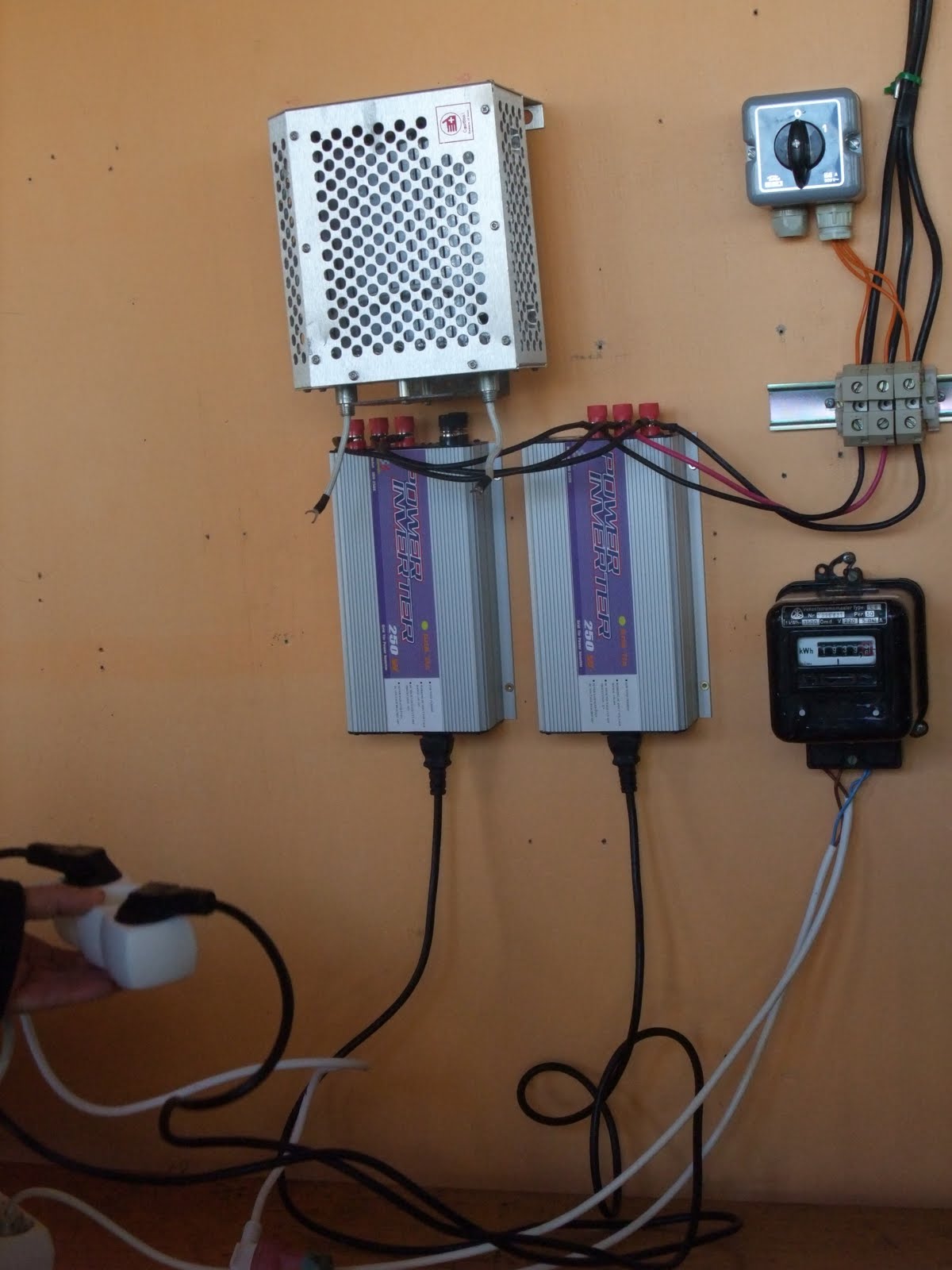 This is the control box for a mini windmill on top of the roof. The left one is directly connected to the grid. You can see a meter as is the black box on the right. The other I believe transform the current from direct to alternate. The big silver box above is a dumpload that is used to, literally, dump the excessive energy generated by the windmill. Yes sometimes it generates so much and if there is not enough consumption in the house it has to be thrown away to keep the system safe. Also, because the price for them to sell back the electricity is cheaper than that with which they buy electricity from the grid, there is not much incentives for them to actually sell it back. The dumpload also exists for other testing purposes.
 And here come all the windmills that are being tested here. Some are owned by NFC. Others are put here by small and medium sized companies for a fee to be tested. In general, the wind speed in this area averages around 5.8m/s, with 3.5 m/s being the starting point for the windmill to work and 25-26 m/s the maximum it can hold without being damaged (beyond that point it should be shut down to protect itself).
There are currently 5200 windmills currently registered throughout Denmark. Yes, like each single one of the living human being, it all has a licence and every drop of electricity it generates is also kept in the book. You should even be able to access these data online in case you want to check their performance or buy an old one.
If I am not mistaken the one on the immediate right side is an old 55 KWp VISTAS. It is 25 meters high till the top of the blade. It has been erected for 25 years and is still good to go for at least another 20 years.
This one is the 6 KWp EasyWind produced by a Germany company for
 primarily for the household market. It costs about 25,000 euros and the payback is estimated to be around 8 years under current electricity prices (flows around 2 DKK/kwh). The power it produces should be enough for family that consumes energy modestly. It can annually produce about 10,000 - 15,000 kWh, depending on wind conditions. It only took the staff seven hours for the whole installation and at the end of day it was ready to produce power. I personally think this is a much better choice than solar PV in windy places like Denmark. Payback time is much better and the same goes for embedded energy life cycle analysis.
For more info, http://www.folkecenter.net/gb/rd/wind-energy/48006/easywind/

But the dialogue is also about scale and balance, time and place. The picture below is an oil producing machine that has been also employed in villages in Mali, Africa. The see
 d plant called Jatropha is squeezed through this machine to produce oil and by-product of soap. Village women in Mali would collect the seeds on and bring them to where the machine is located and then sell the oil (I guess they have to pay a fee for the machine, Jane did not mention it though). It has since become a means to make a living for those women. I dont remember how much this one costs but there is also a Danish model that costs 3500 DKK and produces 8 litre of oil per hour. Ann was thinking about buying one back to Uganda. It is certainly easier said than done, as we discussed later and raise questions such as what type of local plants could be used to grown to produce the oil, how much people are willing to pay to use the machine, where can they sell the oil, will this pose challenge to local food supply...etc. Some particular vegetable oil could also be used for car engine but one needs to add a preheater, converter and filter for it to burn properly and not to harm the engine.
It is not my intention to mention solar hot water, my personal favorite, at

 The left one is broken as you can see the white color at the bottom.
Wednesday, March 17, 2010
a new found architect-- Hundertwasser
I know my post gets a little bit random now as I just tapped into architecture now. Well I am just taking this class on integrated sustainability of architecture and interesting stuff came to me all the time. Such as this Austrian architect Hundertwasser, I would name him Green Gaudi, if you please. Perfect planting of plants and green roofs, together with colors and castles--what else do I need for a home?


a comment by the one posted the picture:
This is an interesting collision that I wanted to record, trees or TVs - should our urban environment should be dominated by screens or plants? But can advertising be displayed on a plant? Can I glean any "information" about the state of our urban environment from a plant?
Ant guess what is this?
an incinerator plant for heating!!
A Small Stove With Big Ambitions
The invention of a tiny stove in India demonstrates the link between reduced carbon emissions and improved health – and how technology can contribute to slowing climate change. Global energy giant BP is producing and marketing Oorja, which means energy in Hindi, a small pellet stove that produces substantially fewer emissions than the traditional wood-burning stoves so common throughout India. In developing the stove, BP ran models by rural consumers. A team of businesswomen based in villages sell stoves and fuel made of agricultural waste products, while also offering BP advice on promoting other energy products to rural India’s millions. The multinational corporation does not expect to earn profit on the product until 2010, and the very poor cannot afford it, but the small stove still points to a new direction. In wealthy and poor countries alike, efforts to control climate changes will require innovative and affordable alternative-energy products, combined with meticulous grassroots marketing campaigns in order to change old habits. – YaleGlobal


world.
SULEBHAAVI, India: As India's richest families race to outfit their kitchens with the latest European trappings, thousands of village entrepreneurs are discovering how to squeeze profits from a squat $17 stove locally designed to reduce global warming and preserve women's health.
Named "Oorja," meaning energy in Hindi, the stove is part of India’s answer to rising concern over India's total emissions – the fourth largest in the world and likely to climb due to surging energy needs and the unveiling of the globe's cheapest car. Unlike many government or NGO-funded projects, this one relies on India’s keen entrepreneurs.
Such businesswomen include Lakshmi Babu Pitagi, who began her career by selling tea door to door in the quiet lanes of Karnataka’s Sulebhaavi village. Now she is part of a rapidly growing network of women recruited to sell an innovative biomass stove run on fuel pellets made from ground nut and other agricultural residues.
Pitagi seeks to liberate her neighbors from relentless eye-watering fumes of traditional wood-burning stoves, which pose serious health hazards and expand India's carbon footprint. And she expresses confidence that she can make money in the process. Within seven months of launching the product, she convinced a quarter of Sulebhaavi's households to purchase the stove.
"This is a lifelong business," crows Pitagi, 33, who makes a slender commission on the hexagonal 675-rupee metal stoves and the 20-rupee sacks of pellets to keep them burning. As she and other vendors learn the trade, they are also educating their boss, global energy giant BP, about the challenges of rural marketing in a culturally diverse nation that’s just beginning to tap into the "base of the pyramid" of consumer power.
Hundreds of millions of Indian villagers still rely on wood-burning stoves, as gas remains a remote luxury in many states. Rural families report that it costs roughly 330 rupees per month, or $8.50, to cook entirely with gas, and many can't save the lump sum required for a gas cylinder. In contrast, BP's vendors pitch the affordability of a weekly supply of two sacks of pellets, which tend to be 50 rupees cheaper than wood purchased in a local market.
On the environmental front, a 2006 report prepared by an independent agency concludes that the stove reduces carbon monoxide by 71 percent and lessens suspended particulate matter by 34 percent. Cooking takes less time because the pellets burn more efficiently than wood, explains H.S. Mukunda, a professor at the Combustion, Gasification and Propulsion Laboratory at the Indian Institute of Science in Bangalore. Biomass use would thus fall from 1.5 to 2 tons per family per year to 0.4 to 0.6 tons per family per year, he says.
The idea of a cleaner stove is hardly novel in India, where indoor air pollution kills nearly 400,000 people each year, according to the World Health Organization.
But in contrast to previous government and philanthropic efforts to simply give away newfangled stoves – programs that have proved largely unsustainable throughout Asia – BP is relying on commercial gusto to spur product acceptance. The company will also test the stove in Vietnam and China later this year.
By giving dealers an incentive to keep supplying the pellets long after they make their first commission on the stove, BP has swerved away from the longtime practice of dumping a stove on consumers and letting them fend for themselves to find fuel.
Pellet delivery trucks roll to Pitagi's door and the company supplies a pamphlet that invokes the Hindu goddess of prosperity and reads, “When you use Oorja, it's like inviting the goddess Lakshmi into your home.”
For the energy giant, however, this is yet to become a profitable venture. The company is striving for greater economies of scale and more technical modifications to erase the 225-rupee gap between the stove's current manufacturing cost and retail price. Citing a "long-term commitment," BP officials decline to release figures on the scale of its investment since the project's low-key launch in late 2006.
Still, with a sales goal of one million stoves by the end of 2009 and a break-even target of 2010, company managers are cheered by the market response, with more than 7,000 new consumers each week purchasing an Oorja stove. The company has recruited and trained entrepreneurs in 2,750 villages across Karnataka, Tamil Nadu and Maharashtra states, where they racked up sales of nearly 200,000 stoves.
Many analysts agree that the commercial approach has better odds for success. "Anything that comes to the beneficiaries for free is not taken seriously," says Pradeep Kashyap, vice president of the Rural Marketing Agencies Association of India. Kashyap, who has evaluated previous stove projects, recalls other stoves that ended up as dusty shoe boxes because government programs typically suffer from "no targets, no accountability, and no responsibility."
But in a country with poor roads, ensuring a reliable network for repairs and pellet supply represents a major challenge for BP. Eschewing national advertising, the company has zeroed in on local tactics, including village fairs, roadside demonstrations and mobile vans. Training sessions tap experienced village entrepreneurs to coach novices.
It's a costly exercise. But BP is betting that the learning process will pay off later when it tries to bring other products into rural markets, including low-cost lighting and heating devices. This is the first time the company has mounted a methodical search for grassroots consumers, although it has made other attempts to diversify into alternative energies, including wind power, solar power and jatropha biofuel.
Ironically, it was a 2001 breakthrough in manufacturing cheap computer fans that led to the possibility of creating a low-cost stove for the masses, recounts Mukunda, whose team had been pondering various designs since 1986.
To be sure, Oorja remains out of reach for the poorest of the poor. Women who walk for hours to collect free firewood in India generally cannot afford a one-time payment of 675 rupees. Entrepreneurs like Pitagi generally refuse to supply the stoves on installments, except when it comes to their own relatives. For all the buzz generated by microfinance initiatives in India, no viable plan has emerged.
"We accept the fact that we don't have the means to reach the people at the extreme lower end of the spectrum," says Sunitha Krishnamurthi, general manager for marketing at BP Energy India Pvt. Ltd, the Bangalore-based unit that is spearheading the Oorja project. "Our audience makes more than $2 a day."
One exception is Lakshmibai Hireappa Sampagani, a 60-year old widow in Karnataka's Itagi village. She makes just 30 rupees (76 cents) a day in the fields, but still managed to buy an Oorja stove last October. "It's not like it was a luxury. It was a necessity for me," she insists. Heavy smoke was bothering her eyes, and she couldn't stand the long walk to collect wood, especially during the rainy season.
Wedged between the mud-packed walls of her narrow kitchen, Sampagani voices a common complaint. "When you don't have enough food to eat, where will you get the money for gas?" she asks, a basic question for housewives all over the developing world. Efforts to devise and refine local solutions like Oorja are essential to easing the painful daily struggle for affordable energy and emission control.
Margot Cohen is a journalist based in Bangalore.
Subscribe to:
Posts (Atom)