Sunday, January 31, 2010

City Car, a Carbon-Free, Stackable Rental Car by MIT Media Lab

learned about this Smart City Smart Cars design from a class. Thought it was pretty futuristically and pragmatically cool.

A team called Smart Cities have designed a two-seat electric vehicle which they call the “City Car” that can be “stacked” in convenient locations (say, just outside a subway stop), and then taken on short trips around urban areas. This technology is patented-pending and under design development at the MIT Media Lab.

The City car utilizes fully integrated in-wheel electric motors and suspension systems called, “Wheel Robots.” The wheel robots eliminate the need traditional drive train configurations like engine blocks, gear boxes, and differentials because they are self-contained, digitally controlled, and reconfigurable. Additionally, the wheel robot provides all wheel power and steering capable of 360 degrees of movement, thus allowing for Omni-directional movement. The vehicle can maneuver in tight urban spaces and park by sideways translation.

The MIT group sees the vehicles as the linchpin in a strategy that aims to mitigate pollution with electric power, expand limited public space by folding and stacking vehicles like shopping carts, and alleviate congestion by letting people rent and return the vehicles to racks located near transportation hubs, such as train stations, airports, and bus depots.

Tuesday, January 26, 2010

Where did alll the fairy tales come from?


I just realize all the "Danish fairy tales" or "Anderson fairy tales", the terms I grew up with, were mostly from the writer Hans Christian Anderson (In Chinese the translation sounds like "an tu sheng" so I did not register at all even though I saw Anderson's name everywhere here). Here I picked an introduction to this writer whom I appreciate for filling up my childhood with tales of adventures and relevance to what life means to an under-10-year-old.

from http://www.kirjasto.sci.fi/hcanders.htm

Danish writer, famous for his fairy tales, which were not meant merely for children but for adults as well. Andersen used frequently colloquial style that disguises the sophisticated moral teachings of his tales. Before achieving success as a playwright and novelist, Andersen was trained as singer and actor. Many of Andersen's fairy tales depict characters who gain happiness in life after suffering and conflicts. 'The Ugly Duckling' and 'The Little Mermaid' are Andersen's most intimate works.
"He now felt glad at having suffered sorrow and trouble, because it enabled him to enjoy so much better all the pleasure and happiness around him; for the great swans swam round the new-comer, and stroked his neck with their beaks, as a welcome." (from 'The Ugly Duckling')

Hans Christian Andersen was born in the slums of Odense. His father, Hans Andersen, was a poor shoemaker and literate, who believed he was of aristocratic origin. Andersen's mother, Anne Marie Andersdatter, worked as washerwoman. Although she was uneducated and superstitious, she opened for his son the world of folklore. Later Andersen depicted her in his novels and in the story 'Hun duede ikke'. Anne Marie declined into alcoholism and died in 1833 in a charitable old people's home. Andersen's half-sister Karen Marie may have worked as a prostitute for a time; she contacted her famous brother only a few times before dying in 1846.

Monday, January 25, 2010

go back to Copenhagen, a little recap of what happended there

I am not trying to be nostalgia here by looking back what is now history. I went to check the Down to Earth issue on Copenhagen, reminded by a friend from Center for Science and Environment in India, where I interned last summer. I even met a co-worker then at the summit, which I'd never expected. I am fond of the sarcastic and still sharp and sober nature of their articles, even thought CSE to me is always romantic and idealistic (they probably won't put it that way).

Most people consider Copenhagen a failure. I think so too. But I also believe failure still means one step toward *success* (in relative terms always, I am a notorious Sophist in Socrates' word I just realize). I came up with a metaphor that descries the individual reflection on COP 15. I am a dandelion seed carrying with me however much enthusiasm, hope and sarcasm (does not appear to you, doesn't it? Well I keep it to myself). The seed was germinated, elevated and bloomed fully right at the beginning of the conference, when negotiations seemed to going and side events panel speakers all exciting about what they have done in the past in fighting climate change. And then it suddenly, but not without weather forecast, got smashed and blown away by the seaside wind in Copenhagen. The bits and pieces went all about. One piece of the new me residing in one of the fuzzy fragments, with my ever-lasting ever-optimistic ever-idealistic seed of hope, landed in a new place, ready to come out again in the spring. Yet it is the practical matters, after all, that keep the romantic me going. Practical matters at present refer to what I have observed and learned from folks all over the world working in the practical field of climate change mitigation and adaptation.

Okay, my metaphor stops here for now. Here is what the Down to Earth colleagues portrait what happened during the last two days of the now history COP 15.

At Copenhagen, unfortunately, industrialized countries sabotaged all possibilities of progress. They had something else in mind. When the COP-15 (Conference of Parties) started, negotiators were barely closer to a deal than they had been in Bali.

If anything there had been regression during the last one year of negotiations.

But failure was not an option. One hundred and ten heads of state were flying to Copenhagen to sign a declaration; they could not all return with their pens unused. More than that, the Nobel prize-winning US president had to emerge as a dealmaker. So in the final 48 hours, negotiators—who had laboured for years for a comprehensive deal—were brushed aside; heads of state, ministers and their top advisers took over.

Leaders started making deals in secret, in the middle of the night, in backrooms, on the fly. Carrots were offered; sticks were wielded. In the end, industrialized countries, with the last-minute complicity of India and China, penned an alarmingly weak deal—the so-called Copenhagen Accord—that appears designed to undermine the negotiations to date. Certain basic rules seem to have been changed forever. Under the captaincy of the US, historical responsibility of the developed world in creating the climate crisis has been erased. The differentiation between rich and poor countries is gone. The rich world does not want to reduce emissions, but is trying hard to stunt the development of the poor world.

The Copenhagen Accord was not officially endorsed. A few developing countries vocally opposed the document and the drafting process. But the accord—rather than any of the documents drafted through two years of multilateral negotiations—emerged as Copenhagen’s only substantive outcome. It could well become the new starting point for future negotiations. This will be disastrous for the developing world.

Thursday, January 21, 2010

Copenhagen as the classroom:sustainable urban design

Classes started today. Way better than the orientation. I begin to have a sense of what the Danish school means by Copenhagen as the classroom and Europe a learning and testing ground. There is of course so much to discoverfrom the heavy history of the Old world--Germany for one thing, a study of its own right. Many of the instructors are real-time practitioners in the field of the subject the teach--they work in Danish urban design, architecture, etc. firms, and do projects all over the world.


Never expect to find out so much about the science behind the way Copenhagen as an urban environment was built and is being built. CPH was the second (or maybe the first) to have pedestrian street, and its pedestrian priority streets work out pretty well as fine (cars and bikes are allowed but pedestrians are given the priority and these streets are usually mixed with pure pedestrian streets at 20% vs 80%).


A big complex of buildings are usually left free space in the center, mostly to get sunlieght into the buildings.


The marble surface in the Store Plaza was once too smooth and slippery. One day after it rained an old lady slipped on it and broke her hip. She sued the city and a shop owner donated some money to hammer the surface to make it somewhat rocky (individual philanthropic gestures were uncommon in Europe at that point, quite a difference with that in the U.S. but not without reason.


Copenhagen as the classroom: living with a Danish family. Having essentially stayed with three families in the last month or so, I deserve to have a say over.The difference I had with the British couple, the Danish host family and the American/Danish/Swedish family.


The Ronsholt family's comments about Danes being the happiest people in the world.Things generally work here. But maybe it is just a matter of communicational barrier or maybe there is more to be discovered and understood. Life seems so monotonic with these middle-class families but it just takes a little bit of initiatives to stir up some fun. And cooking is always the most fun thing to start with!

Tuesday, January 19, 2010

From Haiti's ruins, a chance to rebuild a nation

I have always fancied about reconstruction after a calamity of this magnitude, just like a Hollywood cliche that is played over and over again. But here is a real one and the challenge is how could something revolutionary, futuristic and sustainable could be planned and realized upon the ruins if at all. While it is undoutedly the golden time to implement a blueprint from scratch, who is to plan this and how will it be implemented really for the benefit of the Haitian people? Do the world other than the Haitian government at a rightful position to plan this all? Just just some general outsider questions. I am sure the "development veterans" will come up with specific appropriate planing that fits what the Haitians really need and all that. But anyway despite all that, I think this is a very provocative article that invites deep thinking and also have good points on how the Haitian economy before the earthquake was crashed by U.S. domestic agricultural and trade policies.

Washington Post

Sunday, January 17, 2010

Even as rescuers are digging victims out of the rubble in Haiti, policymakers in Washington and around the world are grappling with how a destitute, corrupt and now devastated country might be transformed into a self-sustaining nation.

Development efforts have failed there, decade after decade, leaving Haitians with a dysfunctional government, a high crime rate and incomes averaging a dollar a day. But the leveled capital, Port-au-Prince, must be rebuilt, promising one of the largest economic development efforts ever undertaken in the hemisphere -- an effort "measured in months and even years," President Obama said Saturday in an appeal for donations alongside former presidents Bill Clinton and George W. Bush. And those who will help oversee it are thinking hard about how to use that money and attention to change the country forever.

"It's terrible to look at it this way, but out of crisis often comes real change," said C. Ross Anthony, the Rand Corp.'s global health director. "The people and the institutions take on the crisis and bring forth things they weren't able to do in the past."

The early thinking encompasses a broad swath of issues. Policymakers in Washington are considering whether to expand controversial trade provisions for Haiti and how to help fund the reconstruction for years into the future. The rule of law needs to be strengthened, particularly with regard to matters of immediate concern, such as property rights, inheritance issues and guardianship in hard-hit neighborhoods.

And somehow, development officials agree, the recovery effort must build up, not supplant, the Haitian government and civil society, starting with putting Haitian authorities at the center of a single, clearly defined plan to rebuild Port-au-Prince and its environs in a far sturdier form.

"National disasters, as awful as they are, you want to seize those moments, use that awful, awful opportunity, to strengthen the ability of national and local authorities to act for the benefit of their citizens," said Jordan Ryan, the assistant administrator of the U.N. Development Program. There is, to an extent, a development framework in place from efforts underway before the earthquake involving the Obama administration, the United Nations, a huge network of international aid groups and a Haitian government that, despite corruption, was viewed as more reliable than any in years. The United States budgeted $292 million in assistance to Haiti this year, including food aid, infrastructure funds and money to fight drug trafficking. And the Haitian economy grew by 2.5 percent in 2009, despite the global recession.

But some development veterans say a full rethinking is now in order. Gerald Zarr, who was the U.S. Agency for International Development's director in Haiti from 1986 to 1990, said even more must be done to involve the Haitian government. Too often, he said, understandable distrust of local authorities has led the United States and the United Nations to work mostly through the many aid groups in Haiti.

"Haiti's going to have to change. And if they do, we ought to make a commitment to stick with the government of the day to keep the institutional development going," Zarr said. "Unless we are committed to institutional development, I fear Haiti's never going to get off this terrible treadmill it's been on."

Others aren't so sure. Putting more faith in Haitian authorities can be done only if there is a crackdown on corruption, said Stuart W. Bowen Jr., who has witnessed the tension between local empowerment and wasted aid money as special inspector general for Iraqreconstruction.

Because nongovernmental organizations will play a central role for years to come, development veterans say, it will be up to the United Nations to ensure that their efforts are coordinated, as was done after the 2004 Indian Ocean tsunami.

...

But creating a new economy will rest on more than sacks of food and aid dollars, which is why others say the United States should revisit trade policies with Haiti. Over the protest of American textile manufacturers, the United States granted tariff exemptions in 2006 to Haitian-made apparel and, after seeing middling results, in 2008 eased restrictions on using fabrics from certain low-cost countries. By 2009, more than two dozen Haitian companies employed 24,000 people making T-shirts, men's suits and more.

Some experts say that the answer is a rice revival. Until the 1980s, Haiti grew almost all the rice that it ate. But in 1986, under pressure from foreign governments, including the United States, Haiti removed its tariff on imported rice. By 2007, 75 percent of the rice eaten in Haiti came from the United States, according to Robert Maguire, a professor at Trinity Washington University. Haitians took to calling the product "Miami Rice."

The switch to importing rice was driven by U.S. subsidies for its own growers, said Fritz Gutwein, co-director of the social justice organization Quixote Center and coordinator of its Haiti Reborn project. The result in Haiti was a neglect of domestic agriculture that left many of the country's farmers, still the majority of its population, unable to support themselves, fueling waves of urban migration and environmental degradation.

"America needs to look at how its own agricultural policies affect Haiti," Gutwein said.

No one is expecting controversial trade policies to be taken up overnight. But the broader rebuilding effort needs to begin as soon as the initial rescue is over, said Mark Schneider, a former USAID official now with the International Crisis Group. "You can't hope to create any kind of sustainable development if this process doesn't start quickly," he said. "If you don't start it now, something will take the world's attention away from Haiti."

Monday, January 18, 2010

Copenhagen semester has kicked off!

From then on this blog will be dedicated my daily experience living and studying in Copenhagen, with special focus on the Danish sustainability and also bluntness, with a curiosity to seek Danish spirituality, if any. It will also include relevant, irrelevant, serendipitous, reasonless and biased observations, thoughts and quotes.

I stay with a very nice pure Danish host family who are just a little bit less enthusiastic about food than I am (by my standard this is considered to be very good, for those don't know me and food). It takes about 40 minutes to commute every day, including 10 minutes bike ride from home to local train station, 25 min train ride and another 5 minutes bike ride to school. It is a lot of time compared to at MHC. It is a norm here of course. Anyway I am generally excited to bike except now it is a little bit too cold so I take the bus to train station and walk.

The little six-year-old girl at my host family bikes to nearby school on her own and it is a norm here.

Driver's licences is allowed at the age of 18, but most Danes do not own a car until much later. Denmark has no car production whatsoever. Cars are imported goods with heavy tax on it. Cars were just like a rather new thing for a lot Danes. Gas of course if very expensive here as well as most European countries. Our Survival Danish class professor had a comment on how cheap gas is in the States and he wished it was the same here. But I mean, gas is by all means a little bit more properly priced than in the US, considering all its external environmental and social cost. It could be more expensive. It should be.

"Denmark is the Italy of the north, Sweden the Germany."

Danes could be both sky and blunt, and like to drink of course. At least most of them.

Spanish Tapas and Portuguese Nata: three weeks of immersion on the passion land (keep updating)

It took me a week to finish, with quality time spent, my three final papers after the drama in COP 15. I then went on a trip down south, in search of warmer weather, Spanish guitar and Portuguese beach, for some crazy three weeks. Without much planning before hand, I did it (a friend was with me for the first part) within the 1000 USD budget I had estimated to stay in Copenhagen for a month. This was achievable mostly because I "couch surfed" (couchsurfing.org, new way of traveling!) in local people's beds or couches for free and of course I cooked Chinese cuisine in return, exerting the "Chinese Food Diplomacy" I am getting better and better. The couch surfing turned out to be most interesting and memorable part of my trip, giving it a whole new perspective and experience. Because new semester has started here in Copenhagen, I will just briefly lead you through my journey with highlights on the way. I have uploaded most of the pictures at this address: http://photo.163.com/photo/superwangyit/?u=superwangyit#m=0&p=1&n=12 I heard Flickr was blocked also? Just word on the street I have not tried. This is a Chinese website which is really strict about what word I use to descript my picture. I was refused twice for having too "sensitive" words, but it was just about a royal garden!!

Anyway, again, stories by pictures.

Spain and Gaudi:

Our time spent in Barcelona was basically devoted to Gaudi. A great master and driving force of modernism, Gaudi drew great inspirations from the nature environment and its inhabitants. And of course there is always this unreasonable human twisting of reality into something unreal and changing. But one has to maze at Gaudi's pieces and wonder how on earth this man thought of this.


Our Barcelona host. A young IT professional, he has a small apartment with a big couch for the two of us. We invited him for a Spanish guitar performance and he brought us to this what he said probably the oldest bar in Barcelona in return. A spit spot left on the mirror was believed to be left by some Spanish philosopher whose name I just slipped away for now. He is actually from southern Spain. But, this guy's got problems as well. We could chat about this over an afternoon tea or sth if you are curious.


A Chinese fruit shop in Barcelona. I just randomly walked in to buy some apples. We started chatting with the Chinese woman--she and her husband owned the shop. I have somehow taken on an anthropological point of view in digging out the story lines behind these Chinese immigrants, after a wonderful immigration/landscape class with Susannah. Just to know more their motives behind all this great human circulation, and there is always more to know from each single one of them.

Tavira, Portugal:

Martin and Beth, a British couple I stayed with in the countryside of a little cute town Tavira. Best part of my journey I consider, as it is always feels at home to come off cities and have a seemingly pollution-free rural life.

Martin Jackson, the husband. Very british and English. He said he and Beth were both hippies were after the green movement during the 70s. But now, he had almost given up on that. He maintained that it had always been that only 2 percent of the population are conscious and know what is really good for themselves and the world. The rest 98% just don't know what is going on. He said he was of course like me 30 years ago and assured me that 30 years later I would be the same as him. I am a little bit concerned, especially because their life right now is where I want to be ultimately. But hell, that is 30 years of "good work" I have done. I just feel that they more he insisted on that the world won't change much the more I am determined to prove him wrong. Well nothing can really be proved and what is really "wrong"?

Beth the wife, very cute woman. She like to recite verses from the Bible to me. It was such a pleasure to listen, her very soft voice. She said despite how crazy the world was now, she just wanted to wait for the New Earth the Bible descried, where lions would slick the sheep and snake plays with rabbit or sth like that. She and Jack met while they were both traveling in India when they were under 20. They were seekers, she said. (Jack would say hippies). They decided to settle in where they are now 30 years ago when they visited their friends nearby. Their two children died in a car crash when they were very young.


To be continued

Thursday, December 24, 2009

Drops during COP 15

stories by pictures 看图说话

Yes things did not turn out to be as fair, ambitious and binding as we all hoped for upon the conclusion of COP 15. Yet in many lights, it was inspiring, constructive and everlasting. I want to share several little a few serendipitous moments when I was struck by what I said, what I heard, what I was part of and what I think it now.

DSCF5277

In the wake of Wednesday 16th riot, the police had pushed back the crowd. I was walking toward Bella Center trying to get in, a guy with a little video camera stopped me and asked me to say a little sth about what I think the solution [to our climate crisis] was. I replied, in gasps, that I think we need to put ourselves in each other’s shoes. We need to understand that we are one people in different forms;our lives connected. He asked me where I was from. I said China. He waved one of his hand whiling the other still holding the camera, “thanks for the Chinese wisdom.”

I don’t know if it is particularly Chinese. I just always remember a peacemaking guru who only sleeps for four hours everyday, once said that we are all one. I just cannot agree more.

DSCF5344

Thursday, 17th. The banner says “change the system, not the climate.” It was in a warehouse that turned into a working station for people who can no longer enter Bella Center. Mekel was delivering a speech within Bella Center. Heads from the governments of the world was doing that one by one. I had no interest in listening. I thought they were all to symbolic and not constructive at all. I realize how hard it was to reach an agreement when at least a few of the big potatoes did not have the sincerity and bona fide; how hard it was to really change the system.

DSC_0487

Tuesday 15th. Robert Swan giving a speech about his expeditions to both Poles. He was the first man to traverse both Arctic and Antarctic by foot. He is now taking young folks to visit an eco-base he set up in Antarctic each year. He ended the presentation with one quote from himself (pretty snobby I have to say): the greatest challenge to our climate crisis is that we think someone else will do the job.

DSCF5255

Monday 14th. I was representing our team to discuss possible venues for youth from the States, India, Japan and China to get together to deliver a joint voice. It proved to be politically difficult as well. First, the Japanese counterparts did not show up. Second, the day after that most of us would not be able to get into Bella Center. Third, the Indians want to have the Indian and Chinese youth talking to Indian and Chinese delegates, in one room, pushing our government and stand closely by the island/African countries (to kill Kyoto and have sth more radical—which was strongly disapproved by both governments).

While sitting on the floor in the absence of wine, we ignored the first obstacle and went crazy with the second one. Reed the American guy proposed that we use radio transmitters to deliver youth voice inside from outside. He said he knew a friend in Copenhagen who invented the bike system(or sth like that) who might have access to such devices. He admitted, very seriously, this idea was crazy but he can always do what he wanted to do without too much idea of how to do it. I proposed what I thought would be fun but less risky – having youth inside holding their computers in a circle, skyping in with youth outside and saying what they want with both voices and images. We all agreed and thought hard of places outside where we had wireless. Later another Indian Friend Linkesh joined and showed us a song he just wrote about Bolivia and their brave commitment as a developing country. We all sang together in a circle:

/Every day their stalling and//they’re saying the same old things again//hm-hm-hm//But one bright country stands apart,//they’re sayin’ things close to my heart.//They’ve got a plan with hope in hand,//They’re sayin’ c’mon let’s just start…//Bolivia//, I wish I was Bolivian//Just one degree temperature rise,//300 ppm in the skies,//cent per-cent emissions down by two thousand forty//Does anyone know the price of waiting//fighting, hating, procrastinating,//hm-hm-hm//My future stands in front of me,// while people here make history,//I hope and pray that it will be,//what the world’s children wish to see…//Bolivia//…//We’ve got to take the boldest steps//there’s work to do; clean up the mess.//hm-hm-hm//My future looks me in the eye,//says to me the time is nigh//It’s time to see the world agree,//time for responsibility!//Bolivia//…/

We dismissed in the urgency of going to the US-China youth joint press release. There was almost no follow-up after that, except I invited the Indian friends to come to a dinner that was just meant for the Chinese team. I will talk about that in a second.

DSCF5329

Thursday 16th. This dinner was just intended for the Chinese team and the Danish organization Energy Crossroads who gave us the chance to participate in COP 15.One team member had a very clever comment on this dinner, which in the end was joined by the Indians and Africans (sorry I had to use the general term, I did not know where in Africa they came from)—when the old generation used “Pingpong Diplomacy” to break the ice between China and the U.S. during the Cold War, we the younger ones used “Chinese food diplomacy.” I dont think it was our intention to have any diplomacy. It was just a very natural gesture for us to invite friends from afar that happened to have chance to gather on the land of fairy tales. If, just a naive thought, everyone in this world could be as native as the the young ones, we probably would have maintained better harmony.

One thing I maintained after COP 15, however disillusioned it could be, is to stay ideal, stubbornly ideal, passionately ideal, naively ideal. With vision and intention, things can be done.

Yes the adults will always tell us “it is more complicated than you can understand.” We should be aware not to grow up with unnecessary sophistication that gets simple things complicated.

Wednesday, December 23, 2009

Requiem For A Crowded Planet—Guardian.com

http://www.monbiot.com/archives/2009/12/21/requiem-for-a-crowded-planet/?utm_source=feedburner&utm_medium=email

recommended to me from a friend at Center for Science and Environment, New Delhi. It is a rather clear-headed comment on the outcome, I think. How many more rounds of talks can we wait?DSCF5318
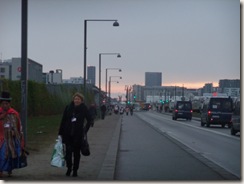
a Mexico women in the far left, heading away from the Bella Center where the sun set, heading home for Mexico?

By George Monbiot. Published in the Guardian 21st December 2009

The last time global negotiations collapsed like this was in Doha in 2001. After the trade talks fell apart, the World Trade Organisation (WTO) assured the delegates that there was nothing to fear: they would move to Mexico, where a deal would be done. The negotiations ran into the sand of the Mexican resort of Cancun, never to re-emerge. After eight years of dithering, nothing has been agreed.

When the climate talks in Copenhagen ended in failure last week, Yvo de Boer, the man in charge of the process, urged us not to worry: everything will be sorted out “in Mexico one year from now.”(1) Is Mexico the diplomatic equivalent of the Pacific garbage patch: the place where failed negotiations go to die?

De Boer might pretend that this is just a temporary hitch, but he knows what happens when talks lose momentum. A year ago I asked him what he feared most. This is what he said. “The worst-case scenario for me is that climate becomes a second WTO. … Copenhagen, for me, is a very clear deadline that I think we need to meet, and I am afraid that if we don’t, then the process will begin to slip, and like in the trade negotiations, one deadline after the other will not be met, and we sort of become the little orchestra on the Titanic.”(2)

We can live without a new trade agreement; we can’t live without a new climate agreement. One of the failings of the people who have tried to mobilise support for a climate treaty is that we have made the issue too complicated. So here is the simplest summary I can produce of why this matters.

Human beings can live in a wider range of conditions than almost any other species. But the climate of the past few thousand years has been amazingly kind to us. It has enabled us to spread into almost all regions of the world and to grow into the favourable ecological circumstances it has created. We currently enjoy the optimum conditions for supporting seven billion people.

A shift in global temperature reduces the range of places than can sustain human life. During the last ice age, humans were confined to low latitudes. The difference in the average global temperature between now and then was four degrees centigrade. Global warming will have the opposite effect, driving people into higher latitudes, principally as water supplies diminish.

Food production at high latitudes must rise as quickly as it falls elsewhere, but this is unlikely to happen. According to the body that summarises the findings of climate science, the Intergovernmental Panel on Climate Change, the potential for global food production “is very likely to decrease above about 3C”(3). The panel uses the phrase “very likely” to mean a probability of above 90%(4). Unless a strong climate deal is struck very soon, the probable outcome is a rise of three or more degrees by the end of the century.

Even in higher latitudes the habitable land area will decrease as the sea level rises. The likely rise this century - probably less than a metre - is threatening only to some populations, but the process does not stop in 2100. During the previous interglacial period, about 125,000 years ago, the average global temperature was around 1.3 degrees higher than it is today, as a result of changes in the earth’s orbit around the sun. A new paper in the scientific journal Nature shows that sea levels during that period were between 6.6 and 9.4 metres higher than today’s(5). Once the temperature had risen, the expansion of sea water and the melting of ice caps in Greenland and Antarctica was unstoppable. I wonder whether the government of Denmark, whose atrocious management of the conference contributed to its failure, would have tried harder if its people knew that in a few hundred years they won’t have a country any more.

As people are displaced from their homes by drought and sea level rise, and as food production declines, the planet will be unable to support the current population. The collapse in human numbers is unlikely to be either smooth or painless: while the average global temperature will rise gradually, the events associated with it will come in fits and starts: sudden droughts and storm surges.

This is why the least developed countries, which will be hit hardest, made the strongest demands in Copenhagen. One hundred and two poor nations called for the maximum global temperature rise to be limited not to two degrees but to 1.5. The chief negotiator for the G77 bloc complained that Africa was being asked “to sign a suicide pact, an incineration pact, in order to maintain the economic dominance of a few countries”(6).

The immediate reason for the failure of the talks can be summarised in two words: Barack Obama. The man elected to put aside childish things proved to be as susceptible to immediate self-interest as any other politician. Just as George Bush did in the approach to the Iraq war, Obama went behind the backs of the UN and most of its member states and assembled a coalition of the willing to strike a deal which outraged the rest of the world. This was then presented to poorer nations without negotiation; either they signed it or they lost the adaptation funds required to help them survive the first few decades of climate breakdown.

The British and American governments have blamed the Chinese government for the failure of the talks. It’s true that the Chinese worked hard to mess them up, but Obama also put Beijing in an impossible position. He demanded concessions while offering nothing. He must have known the importance of not losing face in Chinese politics: his unilateral diplomacy amounted to a demand for self-abasement. My guess is that this was a calculated manoeuvre guaranteed to produce instransigence, whereupon China could be blamed for the outcome he wanted.

Why would Obama do this? You have only to see the relief in Democratic circles to get your answer. Pushing a strong climate programme through the Senate, many of whose members are wholly owned subsidiaries of the energy industry, would have been the political battle of his life. Yet again, the absence of effective campaign finance reform in the US makes global progress almost impossible.

So what happens now? That depends on the other non-player at Copenhagen: you. For the past few years good, liberal, compassionate people - the kind who read the Guardian every day - have shaken their heads and tutted and wondered why someone doesn’t do something. Yet the number taking action has been pathetic. Demonstrations which should have brought millions onto the streets have struggled to mobilise a few thousand. As a result the political cost of the failure at Copenhagen is zero.

Is this music not to your taste sir, or madam? Perhaps you would like our little orchestra to play something louder, to drown out that horrible grinding noise.

www.monbiot.com

References:

1. Yvo de Boer, 19th December 2009. http://unfccc.int/2860.php

2. From transcript of video interview for the Guardian’s “Monbiot Meets” series. You can watch the edited discussion here: http://www.guardian.co.uk/environment/video/2008/dec/08/monbiot-yvo-de-boer-climate

3. IPCC, 2007. Assessing key vulnerabilities and the risk from climate change. Table 19.1. http://www.ipcc.ch/pdf/assessment-report/ar4/wg2/ar4-wg2-chapter19.pdf

4. http://www.ipcc.ch/pdf/supporting-material/uncertainty-guidance-note.pdf

5. Robert E. Kopp et al, 17th December 2009. Probabilistic assessment of sea level during the last interglacial stage. Nature Vol 462, pp863-868. doi:10.1038/nature08686

6. http://www.guardian.co.uk/environment/2009/dec/20/copenhagen-obama-brown-climate

Saturday, December 19, 2009

China-US youth joint press release

Dec. 21:
I could not find the actual word by word document of what we said, but UNFCCC has the recording here:

In fact, for anyone interested in all the press release, side events and open negotiation meetings, you can find it on UNFCCC's website. They are of good quality, presentation slides provided as well. I'd highly recommend skipping through the side events as I found them more pragmatic, promising and informative than the actual negotiations. These side events focus on the groundwork that has been done by various actors under the Kyoto Protocol in addressing climate change mitigation and adaptation.


Left: Holly Jones, we had a great conversation together as we were seated in the same small group at the US-Chinese youth dinner workshop. We were also interviewed together by a freelance journalist writing a story for Wall Street Journal about college students participating in COP 15.
Right: You Zhang, a high school student in Beijing, aged 16, the youngest in our team, but not necessarily the smallest~
Left: our team manager, Holly Chang, a San Francisco born Chinese American, CEO of Goldbridges, a nonprofit organizations dedicated in bridging outside philanthropist/nonprofit organizations with local Chinese grassroots nonprofits.
Right: Ben Wessel, a leader of the SustainUS American youth delegation.
Two our of team photographers shooting each other. Me in blue. A journalist from China Daily asking question. I forgot the content, you can find it toward the end of the press release.

We were supposed to release a joint statement declaring our shared stance to our leaders in pushing for a FAB agreement at Copenhagen. Yet we never delivered, just like our expectation to COP. We could have released way earlier, but there was some disagreement with the US counterparts at the time. And the towards the end of negotiation, we found ourselves in dilemma as whether we should do it at all--when Hillary announced 100 bn USD promise, on condition that China agree to MRV (ie. providing measurable, reportable and verifiable emission reduction data and open to international examination). Hillary totally turned the table against China at the last moment, leaving the choice for China to either loose its face and save the deal or save its face loose the deal (this is a rather obvious question for many of us but for many present leaders in China, face is more important than anything else). We were afraid any statement we have could be used against the Chinese government (eg. even the Chinese youth is pressuring its own government, which put the whole team in some kind of jeopardy, or were bribed by the US government, etc.). We were aware that we did not have this sort of brand opportunity to publicize and manifest our hope for a shared understanding and future, minimizing the cultural and political barriers. We made decision to step out of the muddy water and seek some other chance to deliver the statement.
I have the draft statement but I am sure if I should post it here. Anyone interested could ask me for it and any inputs will be appreciated.
I'd highly recommend this blog if you are interested in more COP 15 and green economy issues in general related to China http://greenleapforward.com/

Posted by Picasa